

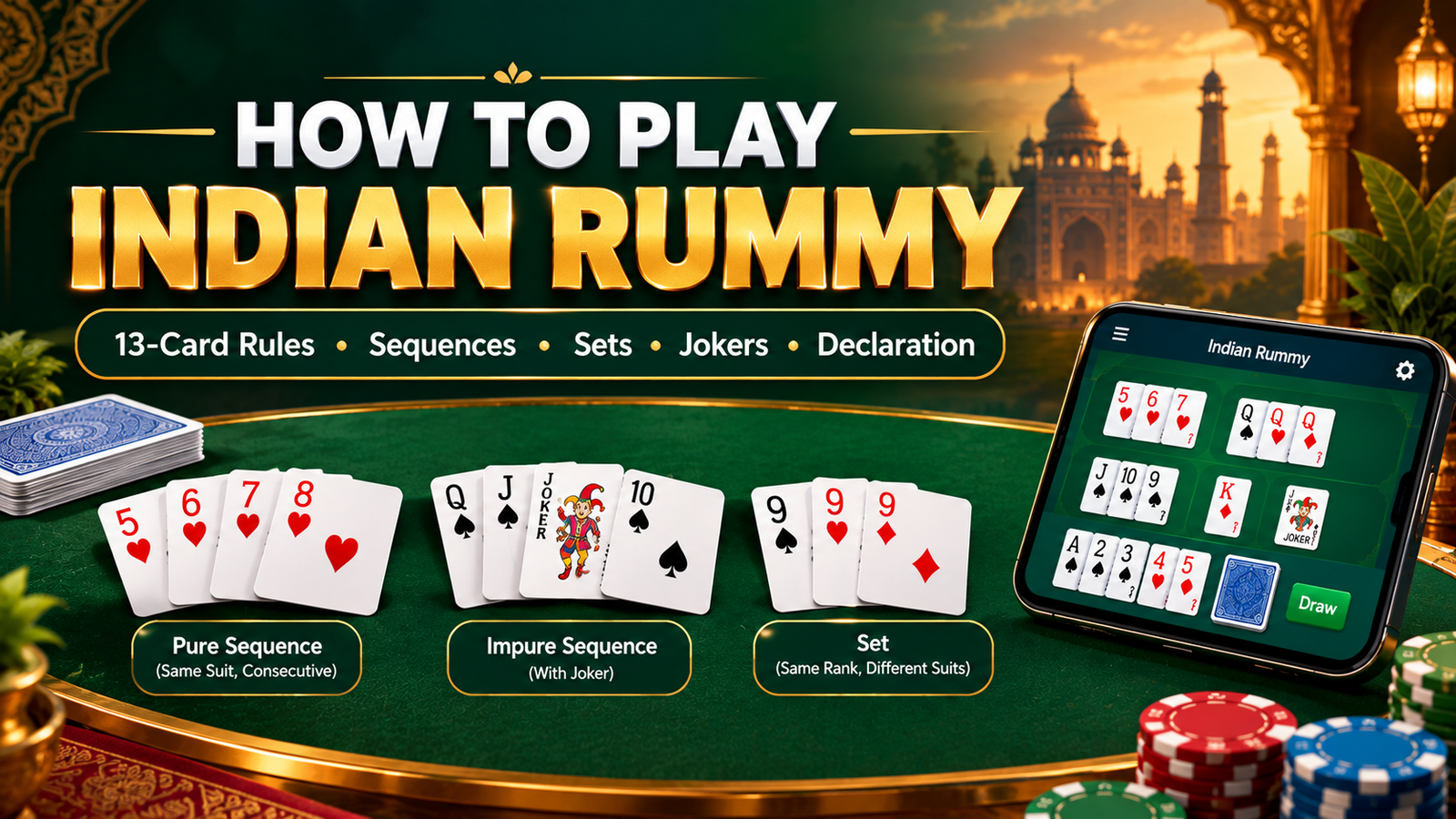
How to Play Indian Rummy is one of the most common questions asked by beginners who are new to the 13-card format. The basic concept is simple: arrange your 13 cards into valid sequences and sets, then make a valid declaration before your opponents.
In this guide, we explain Indian Rummy step by step, including the rules, sequences, sets, Jokers, drawing and discarding cards, declaration, and useful beginner tips.
What Is Indian Rummy?
Indian Rummy is a draw-and-discard card game in which each player generally receives 13 cards. The objective is to arrange all cards into valid combinations and declare your hand.
A standard valid hand normally requires:
- At least two sequences
- At least one pure sequence
- All remaining cards arranged into valid sequences or sets
The exact scoring and some table rules can vary depending on the particular rummy format or platform.
How to Play Indian Rummy Step by Step
Step 1: Receive 13 Cards
At the beginning of the round, each player receives 13 cards. The remaining cards form the closed or draw pile, while another card is placed face-up to begin the discard pile.
Your first objective should be to look at your cards and identify possible sequences.
Step 2: Understand Your Cards
Separate your cards according to their suits and numbers.
For example:
5♥ – 6♥ – 7♥
These cards can form a sequence because they are consecutive and belong to the same suit.
You should also look for cards with the same rank that could potentially form sets.
Step 3: Create a Pure Sequence
A pure sequence consists of three or more consecutive cards from the same suit without using a Joker as a substitute.
Example:
4♠ – 5♠ – 6♠
Another example:
9♥ – 10♥ – J♥ – Q♥
A pure sequence is particularly important because a valid declaration normally requires at least one pure sequence.
Step 4: Create an Impure Sequence
An impure sequence uses a Joker to substitute for a missing card.
For example:
7♦ – 8♦ – Joker – 10♦
Here, the Joker can represent the missing 9♦.
Impure sequences can be useful for completing combinations when you do not have the exact card you need.
Step 5: Understand Sets
A set consists of cards with the same rank but different suits.
For example:
8♠ – 8♥ – 8♦
This is a valid set.
Another example:
K♣ – K♦ – K♥ – K♠
A set can help you arrange cards that cannot easily be used in sequences.
Step 6: Draw One Card
After identifying your potential combinations, your turn begins.
You generally have two options:
Closed Deck:
Take the top card from the face-down pile.
Open/Discard Pile:
Take the visible card from the discard pile.
Choose the card that is most useful for completing your sequences or sets.
Step 7: Discard One Card
After drawing, you temporarily have 14 cards.
You must then discard one card so that your hand returns to 13 cards.
Try to discard cards that:
- Do not fit any sequence
- Do not help create a set
- Have high points but little usefulness
- Are unlikely to help your current combinations
However, avoid discarding cards without considering what your opponents might be collecting.
Step 8: Arrange Your Cards
As you continue playing, keep reorganizing your cards.
For example, your hand could eventually look like:
Pure Sequence:
5♥ – 6♥ – 7♥
Second Sequence:
9♣ – 10♣ – J♣
Set:
4♠ – 4♥ – 4♦
Impure Sequence:
Q♦ – K♦ – Joker
When every card belongs to a valid group and the required sequence conditions are satisfied, you can prepare for declaration.
Step 9: Make a Declaration
Once your 13 cards are properly arranged, you can declare.
Before declaring, carefully check:
✓ At least two sequences
✓ At least one pure sequence
✓ Every card belongs to a valid group
✓ No invalid set or sequence
A rushed declaration can result in a penalty if the arrangement does not satisfy the rules.
Indian Rummy Example
Suppose your 13 cards are:
3♥ – 4♥ – 5♥ → Pure Sequence
7♠ – 8♠ – 9♠ → Pure Sequence
K♣ – K♦ – K♥ → Set
2♦ – 3♦ – Joker → Impure Sequence
This arrangement contains two sequences, including pure sequences, and a valid set. All 13 cards are grouped, making it an example of a properly structured hand.
How Jokers Work in Indian Rummy
Jokers are useful cards because they can substitute for missing cards in eligible combinations.
There are commonly:
- Printed Jokers
- Wild Jokers
A Joker can generally help complete an impure sequence or set, but it should not be treated as a substitute when creating a pure sequence.
Beginner Tips for Indian Rummy
1. Build Your Pure Sequence Early
Your first priority should generally be identifying a possible pure sequence.
2. Don’t Keep Unnecessary High Cards
Cards such as A, K, Q and J can carry higher points in many scoring systems, so keeping useless high cards can increase your potential penalty.
3. Watch the Discard Pile
Pay attention to which cards opponents pick and discard. Their choices may provide clues about the combinations they are building.
4. Use Jokers Carefully
A Joker can be valuable. Instead of using it immediately, consider where it can complete the most useful combination.
5. Check Your Hand Before Declaring
Never declare simply because your cards look organized. Check every group individually.
Common Mistakes Beginners Make
New players often make these mistakes:
- Not creating a pure sequence
- Declaring too quickly
- Ignoring the discard pile
- Holding unnecessary high-value cards
- Using Jokers inefficiently
- Creating an invalid set
- Forgetting that every card must belong to a valid group
How to Improve Your Indian Rummy Skills
The best way to understand How to Play Indian Rummy is to practice the basic process repeatedly:
Sort → Identify Sequences → Create Sets → Draw → Discard → Rearrange → Check → Declare
Once you understand this cycle, the game becomes much easier to follow.
For beginners, free or practice versions can be useful for learning the card combinations before moving to more advanced formats.
Conclusion
Learning How to Play Indian Rummy becomes easy once you understand the basic structure of the 13-card game. The key concepts are pure sequences, impure sequences, sets, Jokers, drawing, discarding and valid declaration.
Start by learning how to create a pure sequence, then work on your second sequence and arrange your remaining cards into valid groups. Most importantly, check the specific rules of the format you are playing because scoring and some gameplay conditions can differ.