

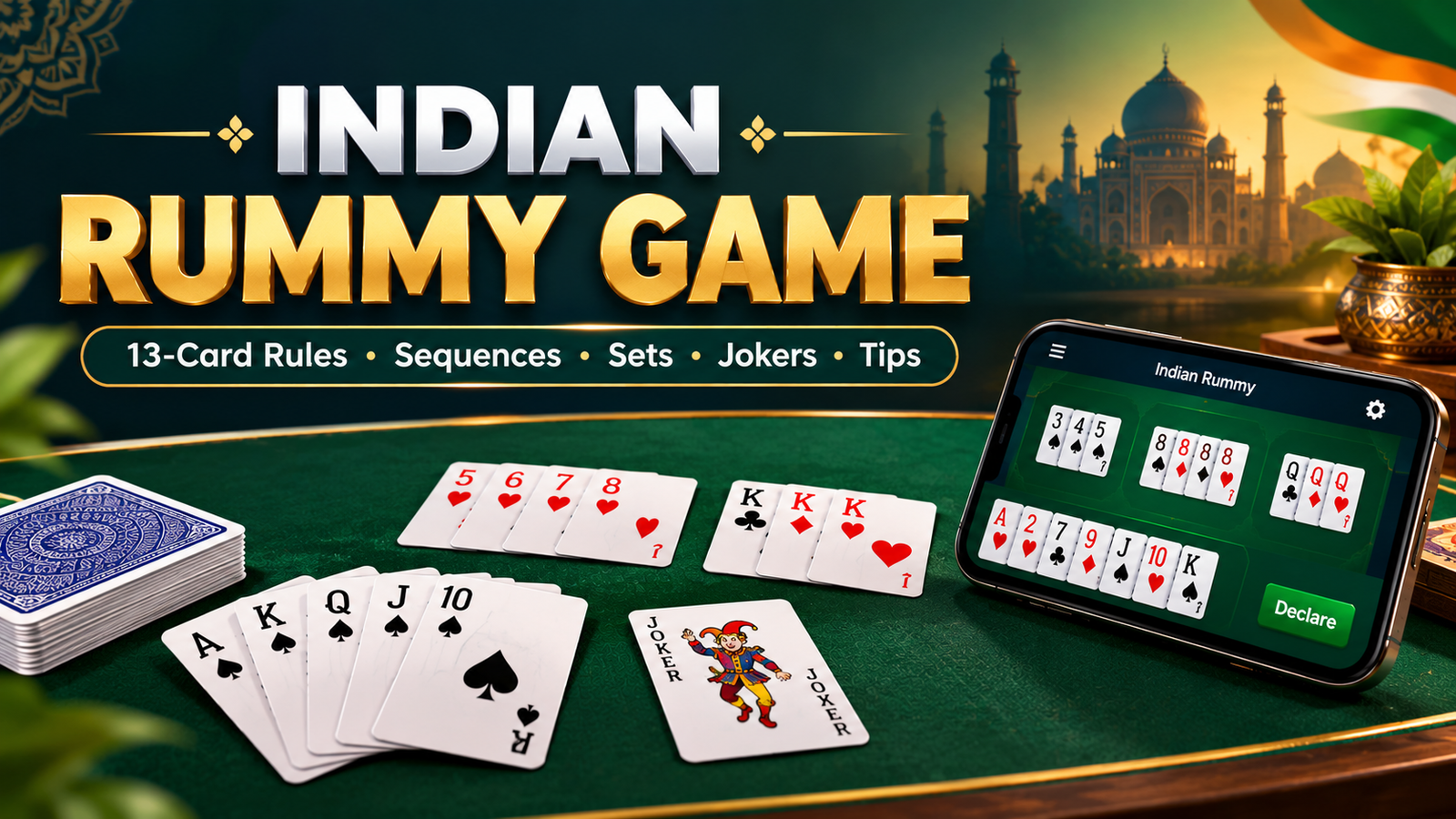
Indian Rummy Game is a popular 13-card card game based on forming valid sequences and sets. The game combines observation, planning, memory and decision-making. In the standard format, players draw and discard cards turn by turn and try to arrange all 13 cards into valid combinations before making a declaration.
What Is Indian Rummy Game?
Indian Rummy is generally played in the 13-card format. Each player receives 13 cards and attempts to arrange them into different groups called sequences and sets.
The main objective is to create a valid hand containing the required sequences and then make a valid declaration.
The basic gameplay is simple:
- Receive 13 cards
- Draw one card
- Discard one card
- Create sequences and sets
- Complete a valid hand
- Make a declaration
Understanding Sequences in Indian Rummy
A sequence consists of consecutive cards of the same suit.
Pure Sequence
A pure sequence contains consecutive cards of the same suit without using a Joker as a substitute.
Example:
5♥ – 6♥ – 7♥
This is a pure sequence.
A pure sequence is an important part of a valid 13-card declaration.
Impure Sequence
An impure sequence can use a Joker to complete the combination.
Example:
5♠ – 6♠ – Joker – 8♠
Here, the Joker substitutes for the missing 7♠.
What Is a Set in Rummy?
A set generally consists of three or four cards having the same rank but different suits.
For example:
8♠ – 8♥ – 8♦
This forms a valid set.
Sets are useful for arranging the cards that are not being used in sequences.
How Jokers Work
Jokers can make it easier to complete combinations. Depending on the particular version or platform, there can be printed Jokers and a designated wild Joker.
For example:
10♣ – Joker – Q♣
The Joker can represent the missing Jack in an impure sequence.
Players should always check the specific table rules because Joker selection and some scoring details can vary between formats.
How to Play Indian Rummy Game
The basic turn-by-turn process is straightforward:
1. Arrange Your Cards
After receiving 13 cards, first look for cards that can form consecutive combinations.
2. Create a Pure Sequence
Building a pure sequence early can help you organize the rest of your hand.
3. Draw a Card
On your turn, you normally choose a card from the closed deck or the visible discard pile.
4. Discard a Card
After drawing, discard one card that is less useful for your combinations.
5. Build Remaining Groups
Continue creating sequences and sets until your complete hand satisfies the required conditions.
6. Declare
Once your cards are correctly arranged, you can make a declaration according to the rules of the particular game.
Popular Indian Rummy Formats
Different rummy platforms may offer different formats. Common formats include:
- Points Rummy
- Pool Rummy
- Deals Rummy
- 13 Card Rummy
- Free/Practice Rummy
The rules, scoring system and table conditions can vary, so players should read the rules displayed for the selected format before starting a game.
Indian Rummy Game Strategy Tips
Knowing the rules is only the beginning. Better decision-making can improve your gameplay.
Focus on a Pure Sequence
Try to identify possible pure sequences early. This gives you a clear foundation for arranging the remaining cards.
Avoid Holding High-Value Cards Unnecessarily
If certain high cards are not helping you form useful combinations, keeping them for too long can increase your points if the round ends against you.
Watch the Discard Pile
The cards other players pick and discard can provide clues about the combinations they may be building.
Use Jokers Carefully
Don’t automatically use a Joker wherever possible. Consider where it provides the greatest value to your overall hand.
Keep Your Hand Flexible
Instead of committing too early to one combination, look for multiple possible sequences and sets.
Common Beginner Mistakes
New players often make a few avoidable mistakes:
- Forgetting the pure-sequence requirement.
- Holding unwanted high cards for too long.
- Ignoring the discard pile.
- Using Jokers without considering better combinations.
- Declaring before checking every group.
- Failing to read the specific rules of the selected format.
Indian Rummy Game Online
Today, Indian Rummy can also be experienced through digital platforms and free-play applications. Online interfaces can make it easier to sort cards, identify groups and understand the game flow.
For beginners, free or practice formats can be useful for learning sequences, sets, Jokers and declarations before considering any other format.
If playing any online version, always check the applicable rules, age requirements, platform terms and current laws in your location.
How to Improve Your Rummy Skills
Improvement comes mainly through understanding combinations and making better decisions.
A useful learning routine is:
Learn Rules → Practice Sequences → Understand Jokers → Observe Discards → Improve Card Selection → Practice Valid Declarations
The more familiar you become with different card combinations, the easier it becomes to recognize useful possibilities in your hand.
Conclusion
Indian Rummy Game is a strategic card game where players arrange 13 cards into valid sequences and sets. Understanding pure sequences, impure sequences, sets, Jokers, drawing, discarding and declarations is essential for beginners.
Rather than focusing only on winning quickly, new players should first learn the rules and practice arranging cards correctly. A strong understanding of the basic gameplay provides a better foundation for developing more advanced rummy strategies.